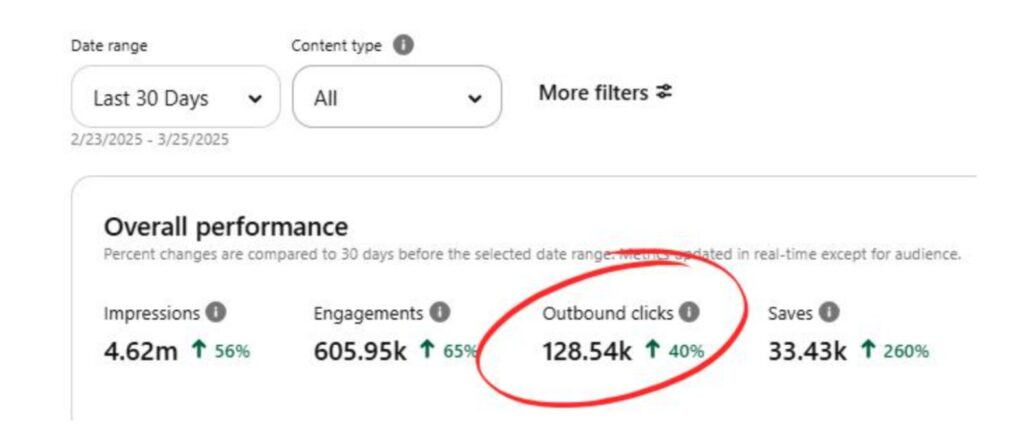
Imagine opening Pinterest Analytics and seeing 100,000 impressions. ONE HUNDRED THOUSAND. You’re feeling pretty good about it all, right? Then you open your website analytics to see how many people Pinterest sent to your blog. And… crickets.
Wait. What?
How can Pinterest show your content to thousands of people while your website barely receives any traffic?
If you’ve experienced this, you’re definitely not alone. And before you decide Pinterest isn’t working, I want to explain something that might completely change how you look at your analytics.
Pinterest Impressions Don’t Mean Website Visitors
One of the biggest misunderstandings about Pinterest is what an impression actually means. According to Pinterest, an impression is counted when your Pin appears on someone’s screen. That’s it, that’s all it takes. It doesn’t mean they clicked your Pin, visited your website, read your blog post, or even stopped scrolling long enough to really look at it.
Your Pin simply appeared.
Now, impressions aren’t bad! They tell us Pinterest is distributing your content, which is a good thing. But if your goal is getting people to your website, impressions are only part of the story. And honestly, they’re not the number I’d spend the most time obsessing over.
The Three Pinterest Metrics You Need to Understand
Before we talk about improving your traffic, let’s clear up three numbers you’ll see in Pinterest Analytics.
- Impressions: The number of times your Pins appeared on someone’s screen.
- Pin clicks: The number of times someone clicked your Pin to take a closer look on Pinterest.
- Outbound clicks: The number of times someone clicked a link that takes them away from Pinterest, potentially to your website.
See the difference?
Someone can see your Pin without clicking it. They can click your Pin without visiting your website. And they can save your Pin without ever leaving Pinterest. All of those actions tell you something different about how people interact with your content. For bloggers and business owners who want website traffic, outbound clicks are especially important.
Why People Aren’t Clicking Through to Your Website
Let’s say you created a beautiful Pin about five ways to improve your Instagram bio. Your graphic includes all five tips. Someone finds it, reads everything, saves it for later, and moves on. They got exactly what they needed without visiting your website.
And that’s not necessarily a bad thing.
You created something helpful! But if your goal was getting that person to read your blog post, the Pin didn’t accomplish what you hoped. This is why I think we need to be intentional about how we create Pinterest content. You want to give people enough information to understand why your content is valuable, while also giving them a reason to learn more.
Not clickbait. Not withholding basic information just to force a click. I’m talking about creating a genuine connection between what your Pin promises and what your website delivers.
Your Pinterest Pin Needs a Reason to Click
Think about the last time you clicked something on Pinterest. You probably wanted more than what you could see in the graphic. Maybe you wanted the full recipe, a tutorial, product details, or an explanation of how something works. That’s the experience I’d encourage you to create.
Instead of putting an entire tutorial on one graphic, consider introducing the problem and showing readers where they can find the complete solution.
For example:
Pin headline: “Why Your Instagram Bio Isn’t Helping People Find You”
Blog post: A detailed guide explaining searchable Instagram bios, keywords, and examples.
The Pin introduces a problem. The blog post helps solve it. And the person clicking knows exactly what they’re going to get. That’s a much stronger connection than creating a pretty graphic and hoping people decide to visit your website.
Check Your Outbound Click Rate, Too
This is another number I’d pay attention to. Your outbound click rate. Pinterest calculates this by comparing outbound clicks with impressions. For example, if your Pin receives 10,000 impressions and 100 outbound clicks, that’s a 1% outbound click rate.
That percentage helps you understand how often people are leaving Pinterest after seeing your content.
And when you compare Pins covering similar topics, it can reveal which headlines, designs, and ideas are encouraging more website visits. Don’t assume there’s one perfect percentage every account should achieve. Your niche, audience, content, and goals all matter. Instead, compare your own Pins and look for patterns.
Make Sure Your Website Matches Your Pin
Sometimes your Pin isn’t the problem. Your destination might be. If someone clicks a Pin promising a beginner’s guide to Pinterest SEO and lands on a generic homepage, they’re probably going to be confused.
And they might leave.
Make sure your Pins link directly to the relevant blog post, product, or resource. Your headline should match what people find after clicking. And your website should be easy to navigate, especially on mobile devices. Getting someone to click is wonderful. Giving them a reason to stay is even better.
Stop Measuring Pinterest Success by Impressions Alone
I love it when content reaches more people. Who doesn’t? That’s why we are doing all of this! But I’d rather have a Pin with 2,000 impressions sending interested readers to my blog than one with 100,000 impressions and almost no website visits.
Because my goal isn’t just to be seen.
I want people to discover my content, find something useful, and hopefully come back again. That’s what makes Pinterest such a valuable platform for bloggers and small business owners. It can connect people who are actively searching for ideas with the content we’ve already worked so hard to create.
So the next time your Pinterest impressions are climbing but your website traffic isn’t, don’t automatically assume your strategy has failed. Look at your outbound clicks. Review your Pin designs. Check your links. And make sure you’re giving people a genuine reason to visit.
Visibility is wonderful. But if website traffic is your goal, measure the actions that actually bring people there.
Your Morning Coffee Just Got More Interesting. ☕
Creator news, social media updates, internet culture, and content strategy delivered straight to your inbox every weekday. Five quick emails. Five interesting reads. Just the stuff worth knowing, without having to search for it yourself.
___
FAQ
Why are my Pinterest impressions high but my outbound clicks low?
Your Pins may be appearing in search results and recommendations without giving people a strong reason to visit your website. Review your headlines, graphics, descriptions, and destination links to see whether they encourage the next step.
What is the difference between Pin clicks and outbound clicks?
Pin clicks measure interactions that open your Pin for a closer look on Pinterest. Outbound clicks measure clicks that lead people away from Pinterest to an external destination, such as your blog or website.
What is a good outbound click rate on Pinterest?
There isn’t one universal benchmark. Your niche, audience, and type of content can affect your results. Instead of chasing a specific percentage, compare similar Pins within your own account and look for improvements over time.
Do Pinterest impressions help grow my website?
Impressions can increase your content’s visibility, but they don’t automatically generate website traffic. People still need to click through to your website for that traffic to happen.
Why doesn’t my Google Analytics traffic match Pinterest Analytics?
Pinterest measures outbound clicks, while Google Analytics measures activity on your website. Some clicks may not result in a completed page load or recorded session. Consent settings, tracking restrictions, and attribution differences can also affect the numbers.
